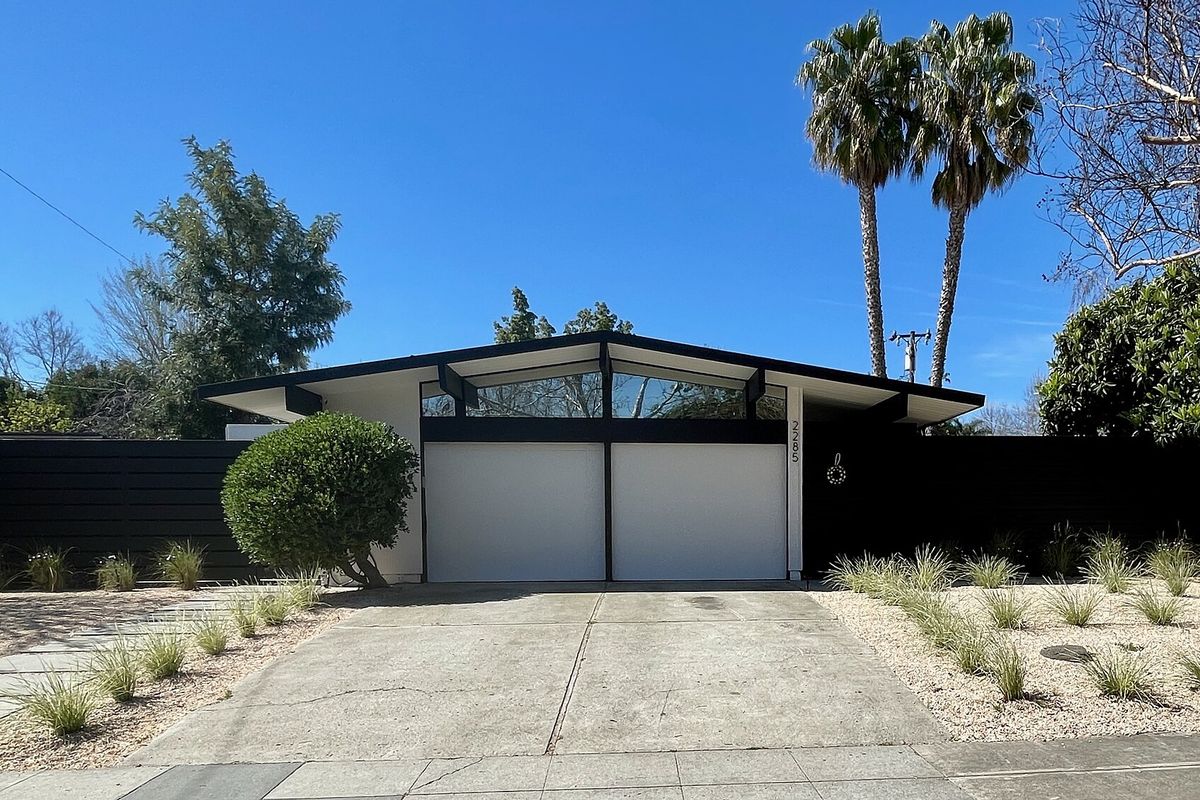
Why is an Eichler roof its own kind of job?
Three things set it apart from a typical Bay Area reroof.
The slope. Eichler roofs are flat or close to it. Even the 1960s center-gable models are "more flat than not," as the Eichler Network puts it, and Sunnyvale's Eichler Design Guidelines describe the style's roofs as flat or shallow, up to a 3:12 slope. Asphalt shingles need more pitch than that under CRC R905, so the flat areas need a membrane, a built-up roof or foam.
No attic. The wood roof deck sits on exposed beams and doubles as the ceiling. Any insulation has to go above the deck, and any damaged deck board that gets replaced will show from inside.
Wiring in the roof. Original Eichler electrical runs were installed beneath the roofing, so a reroof is the one practical window to upgrade wiring or add ceiling fixtures (Eichler Network).
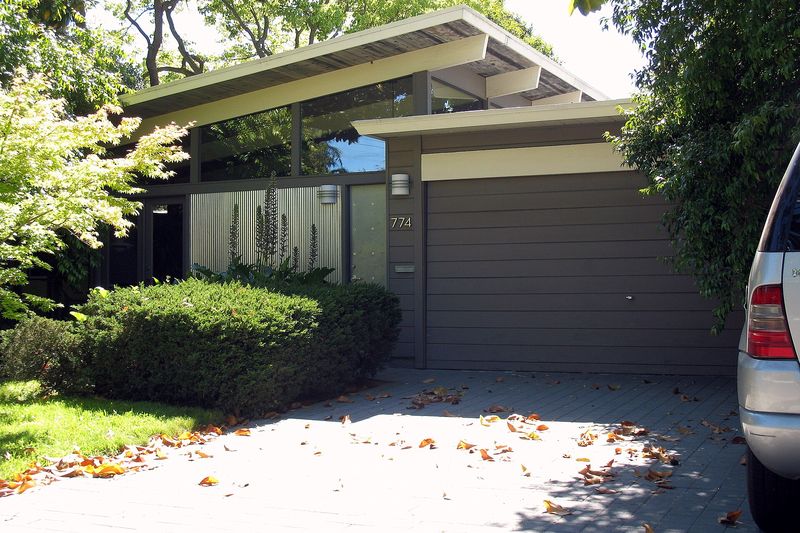
Which roofing systems go on Eichlers?
Four families cover nearly every Eichler reroof in the Bay Area. The comparison guide goes through each one in detail.
| System | How it goes on | Over the old roof? | Life estimate |
|---|---|---|---|
| Built-up (tar and gravel) | Felt layers hot-mopped with asphalt, gravel on top | Generally a tear-off | About 30 years |
| Modified bitumen | Rolled asphalt sheets, often three plies | Generally a tear-off | About 20 years |
| Spray polyurethane foam | Sprayed foam with a protective coating | Often possible | Depends on recoating |
| Single-ply (TPO, PVC, EPDM) | Large sheets with welded or glued seams | Often possible | 7 to 20 years (TPO), 15 to 25 (EPDM) |
Installation methods come from the Eichler Network. Life estimates are InterNACHI figures, not warranties.
Why does insulation go on top?
Because there's nowhere else to put it. The original roofs carried less than an inch of fiberglass, flattened under tar paper and gravel (Eichler Network). Today the choices are rigid foam board fastened over the deck, with the membrane on top, or spray foam, which insulates and waterproofs in one layer. The Eichler Network suggests R-19 as a sensible target for a Bay Area Eichler.
The Energy Code may set a floor. When more than half of a low-slope roof is replaced, homes in climate zones 1, 2, 4 and 8 through 16 need R-14 continuous insulation or an equivalent assembly, with exceptions for roofs that already have R-10 or more and for edges where extra thickness would bury the flashing (§150.2(b)1I). That covers the Santa Clara Valley (zone 4), San Rafael (zone 2) and Walnut Creek and Concord (zone 12). The Peninsula, San Francisco and Oakland are in zone 3, with no insulation requirement. Insulation guide.
Does it have to be a white roof?
In climate zones 4 and 6 through 15, a replaced low-slope roof needs a reflective "cool roof" surface: aged solar reflectance of 0.63 and thermal emittance of 0.75, or an SRI of 75 (§150.2(b)1I, CEC). The code lets you trade reflectance for deck insulation. With R-24 continuous insulation in zones 4 and 8 through 15 there's no reflectance requirement at all, which is one way to keep a darker, more original-looking roof.
The Eichler Network notes the other side of that choice: a bright white roof can bother neighbors who look down on it, while a light roof keeps an un-air-conditioned Eichler noticeably cooler (Eichler Roofing).
What should be planned before tear-off?
- Heating and cooling. Eichlers heat through hot-water pipes in the slab, and roof leaks that wet the slab can damage steel pipes from outside (Eichler Network). If you're adding a ductless mini-split, decide where its line sets and condenser go before the new roof is down. More on radiant heat, AC and wiring.
- Solar. Panels and racking come off for the reroof and go back on after. Ask who handles that and how the new roof is flashed around the mounts.
- Skylights and drains. Replacing old skylights during the reroof avoids cutting into a brand-new membrane later. Skylights, beams and fascia.
How do you keep the look?
The thin roof edge, exposed beam ends and plain fascia are what make an Eichler read as an Eichler from the street. Several cities write that into their rules: Palo Alto's voluntary design guidelines, Sunnyvale's guidelines, Cupertino's R1-e district, San Jose's standards for the Fairglen Additions and San Rafael's Eichler overlay, which sends roof changes that add more than six inches of height or change the pitch to design review. A like-for-like reroof usually needs only a building permit, but extra insulation raises the roof edge, so ask your city early. Permits and design rules.
What should you ask each roofer?
- [ ] Which system do you recommend for this roof, and what's the second choice?
- [ ] Tear-off or recover, and how many layers are there now?
- [ ] How much insulation, of what type, and what does it do to the edge height?
- [ ] How will you detail the fascia, gravel stop, beam ends and skylights?
- [ ] Where will water go: drains, scuppers, any added slope?
- [ ] Who pulls the permit, and does the city need design review?
- [ ] What's the license number? Check it on CSLB.
Every roofer we work with is licensed and insured.
Book a free roof inspectionFrequently asked questions
Can an Eichler get a shingle roof?
Not on the flat sections. California's code sets a minimum slope for asphalt shingles that Eichler roofs don't reach (CRC R905). Some 1960s gable models have steeper center sections, but the rest of the roof still needs a low-slope system.
Does the old roof have to come off?
For new tar and gravel or a three-ply modified bitumen roof, generally yes. Spray foam and most single-ply systems can often go over a sound existing roof (Eichler Network), but the code bars a recover over two or more existing layers or water-soaked roofing (CRC R908).
Will a new roof make my Eichler cooler?
Usually, if insulation goes in with it. Original Eichler roofs had less than an inch of fiberglass under the tar and gravel (Eichler Network), so adding foam board or spray foam changes summer comfort more than any other part of the job.
Sources
- Eichler Network: Eichler Roofing
- City of Sunnyvale: Eichler Design Guidelines (adopted July 28, 2009)
- California Residential Code R905 (roof coverings)
- Eichler Network: Roofing Survival Guide
- InterNACHI: Life expectancy of roofing materials
- Eichler Network: Roof Insulation
- 2025 California Energy Code §150.2(b)1I, roof alterations (Energy Code Ace)
- California Energy Commission: Cool roofs fact sheet
- Eichler Network: Six Myths of Eichler Radiant Heating
- City of Palo Alto: Eichler Neighborhood Design Guidelines (adopted April 2, 2018)
- City of Cupertino: Single-family residential (R1-e Eichler district)
- City of San José: Eichler Neighborhood Objective Design Standards
- San Rafael Municipal Code ch. 14.14: Eichler and Alliance Homes overlay
- CSLB: Check a license
- California Residential Code R908 (reroofing)
Sources reviewed November 17, 2026. Confirm permits, design rules and requirements with your contractor and your city or county. This page is general information, not legal or insurance advice.